Prototype molding and mass production cost advantages
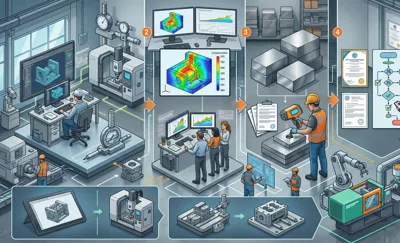
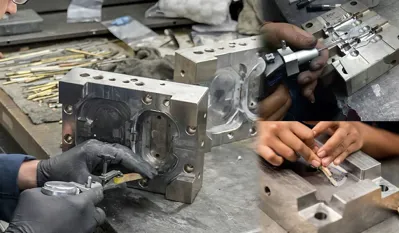
Soft tooling is a pre-series manufacturing method that enables the rapid and low-cost production of 50 to 5,000 actual raw material parts before resorting to costly mass production molds (hard tooling). It is typically manufactured using easily machinable aluminum alloys (Alumec 89, 7075 T6) or pre-hardened mild steels (1.2311). Thanks to soft tooling, assembly, strength, DFM verification, and PPAP sample testing of the final part can be performed under real injection molding conditions, minimizing the risk of high revision costs associated with mass production.

What is Prototype Tooling (Soft Tooling) Before Mass Production?
In the B2B industrial manufacturing sector, transferring a new product or technical component from concept design to mass production involves significant financial and operational risks. Manufacturing hardened steel molds (Hard Tooling) with hundreds of thousands of cycle lifetimes for mass production requires serious capital investment (CAPEX) and weeks of CNC machining processes.
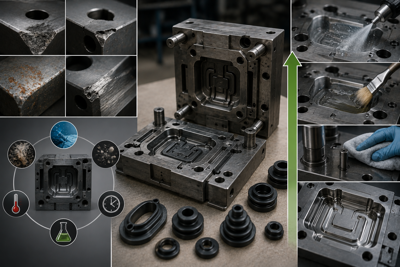
A single dimensional deviation or assembly error overlooked during product development can lead to extremely expensive modifications or complete scrapping of the mold in mass production steel tooling. At this point, prototype tooling (soft tooling) becomes a strategic solution. Prototype tooling is an engineering bridge that eliminates design and assembly risks before mass production by producing low-volume parts under real injection molding conditions using the target production material.
3D Printing (Additive Manufacturing) vs. Prototype Tooling: Which One Should Be Chosen?
One of the most common mistakes during product development (R&D) is relying only on 3D printing technologies (SLA, SLS, FDM) for functional testing and pilot field applications. Although 3D printing technologies are excellent for visual concept validation, they cannot fully represent mass production quality:
-
Layer Bonding and Anisotropy: Due to their layered structure, 3D printed parts exhibit different mechanical fracture resistance compared to injection molded components.
-
Real Material Limitations: Original production materials such as 30% glass fiber reinforced PA66 or high molecular weight EPDM/NBR rubber compounds cannot provide exactly the same mechanical and thermal properties when produced with 3D printing technologies.
-
Quantity and Cost Balance: When prototype requirements reach between 50 and 2,000 pieces, the unit cost and production time of 3D printing become significantly more expensive compared to prototype tooling.
Prototype tooling provides almost identical technical characteristics to final production parts in terms of surface finish quality, mold flow behavior, and shrinkage rates.
Materials Used in Prototype Mold Manufacturing
The main purpose of prototype molds is not long service life, but fast machinability and low production cost. Therefore, materials that do not require steel hardening (heat treatment) and provide excellent machinability are preferred:
1. High Strength Aluminum Alloys (Alumec 89 / 7075-T6)
Aircraft-grade aluminum alloys such as Alumec 89 and 7075-T6 are among the primary materials used in prototype tooling applications. Compared to steel, aluminum can be machined 3 to 4 times faster on CNC milling machines. This reduces mold manufacturing times from weeks to days. In addition, aluminum's high thermal conductivity shortens injection cycle times. Prototype molds produced from aluminum can easily achieve between 5,000 and 20,000 injection cycles.
2. Pre-Hardened Soft Steels (DIN 1.2311 / P20)
For prototype molding applications involving abrasive glass fiber reinforced engineering plastics (such as PA66 GF30) or polymers requiring high processing temperatures, pre-hardened DIN 1.2311 steel is preferred instead of aluminum. Since it does not require additional heat treatment processes, it can be machined quickly and enables prototype production up to 50,000 cycles.
Transition Process from Prototype Mold to Mass Production Mold (Hard Tooling)
The data obtained during the prototype tooling stage provides invaluable engineering input for the manufacturing of the final mass production steel mold. During prototype trials, the following critical parameters are identified:
-
Actual mold shrinkage rates,
-
The effect of injection gate locations on part mechanical strength,
-
Required mold ventilation (venting) requirements,
These engineering findings are transferred into the CAD design of the mass production mold. As a result, the main production steel mold (Class 101/102), designed for millions of cycles, is manufactured with minimized risk and maximum reliability, fully securing the B2B investment.
Frequently Asked Questions (FAQ)
Can prototype molded parts be used in PPAP and certification processes?
Yes. Since prototype tooling is performed directly through plastic injection molding or rubber molding processes using the final production-grade raw material, the produced parts can be reliably used for dimensional inspection reports (CMM), laboratory testing, and initial sample approval processes (PPAP) submitted to customers.
Can complex slider mechanisms be used in aluminum prototype molds?
Yes, they can be used. Mechanical or hydraulic sliders can be integrated into aluminum mold blocks. However, to reduce cost and delivery time, prototype molds often utilize manually inserted and removed steel inserts instead of complex slider mechanisms, significantly lowering additional tooling expenses.
How long does prototype mold manufacturing take?
Depending on the geometric complexity of the part, prototype molds designed with Alumec aluminum alloys are generally ready for T1 trial injection after DFM analysis within 7 to 15 working days.
Eliminate Your Mass Production Risks with Low-Cost Prototype Tooling
Do not risk your project's assembly performance, mechanical strength, and field reliability before investing in high-budget steel molds.
kaucukplastikkalip.com
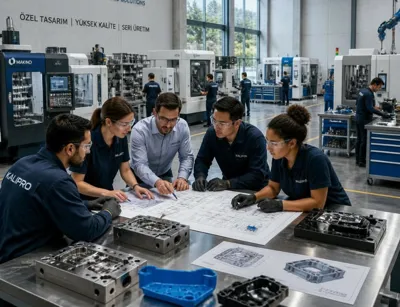
provides prototype tooling solutions using Alumec aluminum and soft steel mold infrastructures. We manufacture real-material prototype parts within 1 to 3 weeks and validate all critical tests before mass production.
Share your 3D CAD data and target prototype quantities with us, and we will prepare the most suitable low-volume B2B tooling solution for your project.
Recommended for You
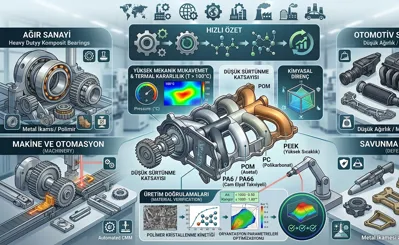
Technical plastic products and industrial applications.
Technical plastic products are components manufactured using engineering plastics (PA6, PA66, POM, PC, PEEK) that, unlike conventional polymers, offer high mechanical strength, thermal stability up to 100°C, chemical resistance, and a low coefficient of friction. They are frequently preferred in metal replacement projects in heavy industry, machinery, automotive, and defense sectors. Production validations are carried out according to ISO 20457 geometric tolerance standards by optimizing the crystallization kinetics and orientation parameters of the polymers.