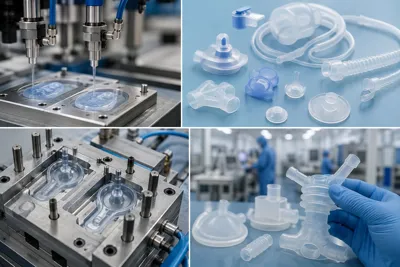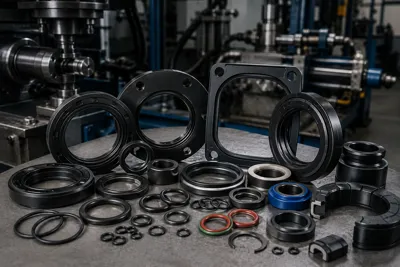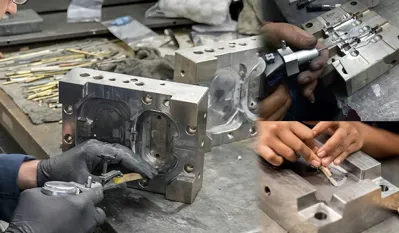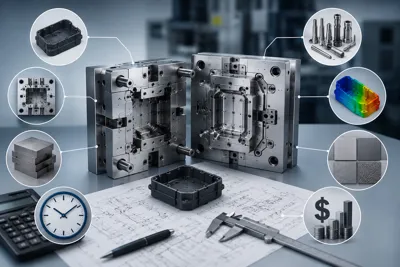
Rubber mold manufacturing and industrial production solutions.
Rubber mold manufacturing is the process of shaping elastomer raw materials through vulcanization reactions under high temperatures (160°C - 200°C) and pressures (50 - 250 bar). Compression, transfer, and injection molding methods are used in industrial production lines. Production tolerances are determined according to the TS ISO 3302-1 standard M1, M2, and M3 classes, while the storage and shelf life criteria of the final elastomeric components are subject to the DIN 7716 standard. High-precision sealing and damping elements are produced for the automotive, defense, and machinery industries using NBR, EPDM, FKM (Viton), and silicone raw materials.

What is Rubber Mold Manufacturing? Basic Engineering Principles
In industrial production processes, obtaining full efficiency from the strength, flexibility, and sealing properties of elastomer materials necessitates a high-precision rubber mold manufacturing operation. Rubber molding differs radically from plastic injection molding. While plastic materials are thermoplastic in character, melting when heated and solidifying when cooled; rubber compounds are thermoset (permanently hardened by heat). This requires the mold to be not only a shaping tool but also a chemical reaction chamber (vulcanization).
Thermoset Structure and Vulcanization Chemistry
Rubber raw material (compound), in its unprocessed state, is a plastic slurry. For this material to be classified as an industrial rubber product, it must react with sulfur or peroxide-based crosslinking agents. The high heat inside the mold transforms linear chains at the molecular level into three-dimensional network structures. This process is called vulcanization. The mold manufacturer must design heating plates and cartridges that ensure the in-mold temperature distribution remains within a ±2°C deviation limit during this chemical curing period.
Shrinkage Rate and Mold Cavity Calculation
In the engineering phase of rubber mold manufacturing, the thermal expansion that the raw material will undergo during the molecular cross-linking period and the subsequent shrinkage during the cooling phase must be taken into account. Each rubber formulation has a different shrinkage rate. Design engineers optimize the steel mold cavities at the micro level according to the shrinkage coefficient of the raw material (usually ranging from 1.5% to 4%). Otherwise, the final products will create geometric mismatches on assembly lines.
Industrial Rubber Molding Methods
In B2B production projects, one of three basic molding methods is selected considering part geometry, annual production volume, raw material viscosity, and cost targets:
1. 1. Compression Molding
This is the most established and widespread method. Pre-weighed and shaped rubber raw material (preform) is placed directly into heated open mold cavities. The mold is closed by means of a hydraulic press. High pressure ensures that the raw material penetrates all cavities. It offers ideal and cost-effective mold solutions, especially for large-sized sealing elements, heavy-duty suspension bushings, and low/medium-volume special manufacturing.
2. Transfer Molding
In this method, the raw material is placed in a pot located at the top of the mold. When the press closes, a piston transfers the raw material through narrow runners into closed cavities. Transfer molding provides high homogeneity and low burr rate in the production of parts with complex geometries, thin sections, or containing metal inserts (rubber-metal bonding).
3. Rubber Injection Molding
It is an indispensable technology for high-volume mass production lines. The rubber raw material is plasticized without melting at an optimized temperature (usually 70°C - 90°C) within a screw-barrel system and injected directly into hot mold cavities (170°C - 200°C) under very high pressure. Cycle times are extremely short. It offers near-zero defects and maximum dimensional stability for automotive sub-industry and OEM manufacturers.
Steel Types and Metallurgy Used in Rubber Mold Manufacturing
Mold life and surface quality are directly related to the mechanical properties of the selected steel alloy. Sulfur, carbon black, and mineral fillers in rubber mixtures create abrasive and corrosive effects on mold surfaces under high temperatures.
Tolerances and Quality Standards: TS ISO 3302-1 and DIN 7716
Dimensional tolerances are the most important aspect for engineers in B2B supply processes.
Because rubber is a flexible material, metal or plastic tolerance standards cannot be applied. The main globally accepted standard in the industry is the TS ISO 3302-1 standard. This standard classifies molded products according to their geometric precision:M1 Class (Precise): This is the narrowest tolerance range applied to aerospace, defense industry and critical medical devices. Mold manufacturing requires the highest level of CNC precision.
M2 Class (High Quality): This is the standard class accepted for the automotive sub-industry, engine sealing elements, and dynamic damping mounts.
M3 Class (Commercial): Used for general machine manufacturing, static sealing gaskets, and industrial rubber products with high dimensional flexibility.
In addition, in order to prevent the manufactured parts from losing their properties during logistics processes and storage, DIN 7716 (Standards for Storage, Maintenance and Cleaning of Rubber Products) should be used as a guide, and mold design and production parameters should be structured in a way that minimizes these aging effects.
Raw Material Matrix in Rubber Part Production
The success of the mold depends on the correct analysis of the characteristics of the raw material to be molded.
The basic elastomer types that can be processed in the molds we designed for factory managers and R&D teams, and their industrial performance data, are as follows:
NBR (Nitrile Rubber): Excellent resistance to oil, fuel and grease. It is preferred in hydraulic and pneumatic sealing elements, o-rings and gaskets.
FKM (Viton / Fluorocarbon Rubber): It is resistant to extreme temperatures up to 250°C and aggressive chemicals/acids. It is used in critical points in the defense, aerospace and chemical industries.
Silicone (VMQ): With its wide temperature range (-60°C to +220°C), food compatibility and high dielectric properties, it is the main input of the medical and white goods sectors.
Cost Factors in B2B Procurement and Specification (RFQ) Processes
When analyzing the cost of rubber mold manufacturing for a technical procurement manager, not only the initial investment (mold cost) but also the cost per part (cycle time and scrap rate) should be calculated. Although a multi-cavity injection mold requires a high initial investment, it radically reduces the unit part cost in high-volume projects. Correctly opening the in-mold gas release (ventilation) channels reduces product scrap, saves raw materials, and directly increases profitability.
Frequently Asked Questions (FAQ)
How is the shrinkage rate calculated in rubber mold manufacturing?
The shrinkage rate in rubber mold manufacturing varies between 1.5% and 4% depending on the type of elastomer used (NBR, EPDM, FKM, etc.), vulcanization temperature, press pressure, and part thickness.
During the design phase, this ratio is added as an allowance to the mold cavities using 3D CAD simulations.
Why is the TS ISO 3302-1 standard important?
The TS ISO 3302-1 standard defines the dimensional and geometric tolerance limits of flexible rubber parts after they are removed from the mold. In B2B procurements, preparing technical specifications according to the M1 or M2 classes of this standard reduces assembly errors to zero.
Which maintenance protocols should be applied to extend mold life?
To extend mold life, mold surfaces should be cleaned with appropriate solvents after each production shift, mold release agent residues should be removed, and periodic maintenance should be performed in ultrasonic cleaning units. In addition, certified hot work tool steels such as 1.2344 should be preferred.
Share your technical specifications for your high-precision rubber mold manufacturing and mass production projects; our R&D, mold design, and engineering team will prepare the most optimized cost-effective B2B offer tailored to you.
Recommended for You
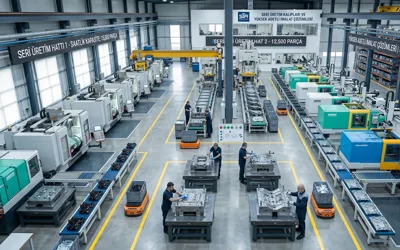
Mass production molds and high-volume manufacturing solutions.
High-volume series production mold manufacturing is an engineering discipline applied to minimize cycle times and increase line efficiency (OEE) to over 85%. In high-volume manufacturing lines, powder metallurgical steels (Bohler M390, Elmax, etc.) with a hardness of 52-54 HRC according to the SPI Class 101 standard and corrosion-resistant DIN 1.2083 alloys are used. In multi-cavity molds, hot runner systems and conformal cooling channels that follow the part geometry in 3D are integrated for a balanced polymer distribution.