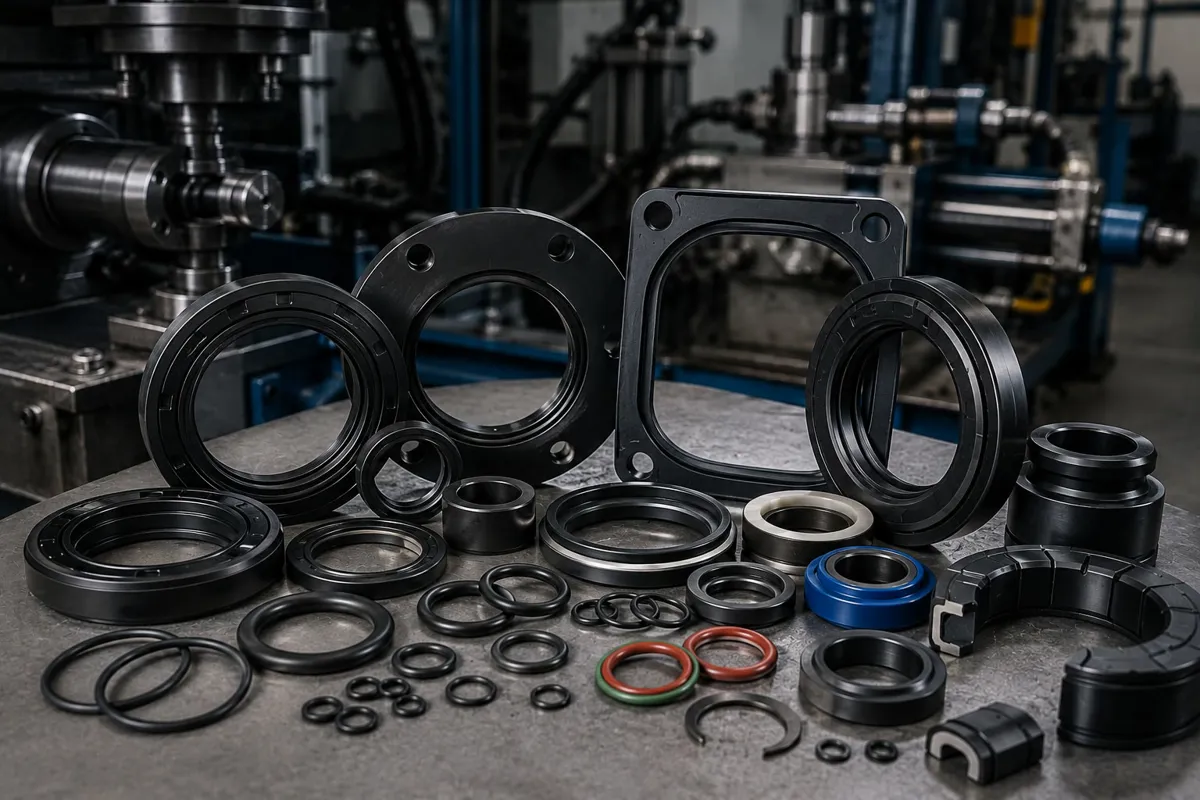
Production of high-strength sealing elements.
The production of sealing elements for the machinery industry aims to prevent fluid loss in hydraulic and pneumatic systems, withstand high system pressures (350 to 700 bar), and minimize dynamic wear. NBR, HNBR, FKM (Viton), and Polyurethane (PU) elastomeric raw materials are used in the manufacturing processes. Production verification is carried out according to DIN 3760 (rotary shaft seals) and TS ISO 3601-1 (o-rings) standards, while the elastic recovery capabilities of the parts are guaranteed by ASTM D395 permanent deformation (compression set) criteria.
Strategic Importance of Sealing Components in Machinery Manufacturing
In B2B industries such as heavy machinery, hydraulic presses, construction equipment, CNC machine tools, and industrial pumping systems, sustainable mechanical performance depends directly on the quality of the sealing components used. Sealing component manufacturing is far more than producing a simple rubber ring; it is a highly specialized engineering discipline involving high hydraulic pressures, sudden cavitation shocks, aggressive synthetic lubricants, and continuous friction under demanding operating conditions.
For machinery manufacturers (OEMs), the failure of a sealing component can result in hydraulic oil leakage, loss of system pressure, and costly production downtime affecting manufacturing lines worth millions of dollars. Therefore, selecting the correct elastomer compound, manufacturing high-precision molds, and complying with international dimensional tolerance standards are top priorities throughout the B2B supply chain.
Types of Sealing Components and Their Operating Principles
Sealing components used in industrial machinery are generally classified into two primary categories according to the type of motion occurring at the sealing interface:
1. Dynamic Sealing: Rotary Shaft Seals (DIN 3760) and Piston/Rod Seals
These sealing systems are used on rotating shafts, hydraulic cylinder pistons, and reciprocating rods. Radial shaft seals manufactured in accordance with DIN 3760 retain lubricating oil inside the system while preventing dust and contaminants from entering, all without causing excessive shaft wear during rotation. In piston and rod seals, increasing hydraulic pressure forces the sealing lips more firmly against the sealing surface, improving sealing performance. These products are commonly manufactured from low-friction, wear-resistant materials such as NBR, FKM (Viton®), and Polyurethane (PU).
2. Static Sealing: O-Rings (TS ISO 3601-1) and Custom Flange Gaskets
Static sealing elements are installed between components that do not experience relative motion. O-rings, the most widely used sealing products worldwide, are dimensioned according to the TS ISO 3601-1 standard. During assembly, the O-ring is compressed by bolt preload, creating an initial sealing force. Once system pressure is applied, the O-ring deforms in the opposite direction of the pressure, filling microscopic clearances and providing an exceptionally reliable static seal.
Material Selection for High-Pressure and High-Temperature Applications
The service life of a sealing component is primarily determined by the resistance of its elastomer compound to hydraulic fluids, pressure, and operating temperature.
-
70–80 Shore A NBR (Nitrile Rubber): An excellent standard material for mineral hydraulic oils, greases, and water-glycol fluids. Operating reliably between -30°C and +110°C, it offers the most cost-effective sealing solution for systems operating up to approximately 200 bar.
-
HNBR (Hydrogenated Nitrile Rubber): Provides significantly higher tear strength and improved thermal resistance compared with conventional NBR, maintaining reliable performance at temperatures up to +150°C. It is widely used in high-pressure hydraulic breakers and heavy-duty hydraulic cylinders.
-
FKM (Viton®): The preferred elastomer for continuous operating temperatures reaching +200°C, aggressive chemicals, and synthetic hydraulic fluids (HEES/HEPR). It is also ideal for high-speed rotary shaft sealing applications.
-
Polyurethane (PU): Offers exceptional resistance to cutting, tearing, and abrasion. It is the primary material used for manufacturing high-performance seals operating in hydraulic systems exceeding 400 bar.
Mold Design and Vulcanization Precision for Sealing Components
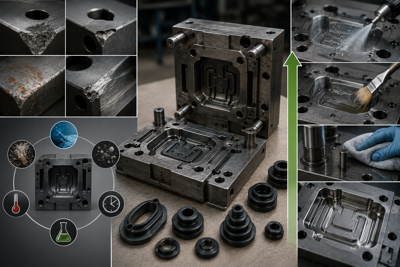
The molding process for sealing components differs significantly from the production of standard rubber parts. Even the smallest flash formation or dimensional deviation on the microgeometry of a sealing lip can directly lead to hydraulic oil leakage and sealing failure.
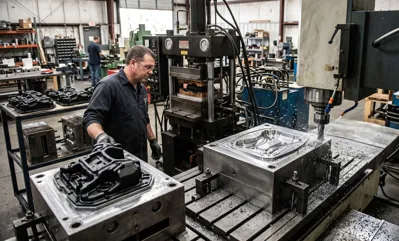
For this reason, sealing molds are manufactured using high-precision grinding and Electrical Discharge Machining (EDM) processes. Parting lines are intentionally positioned away from the sealing surface to eliminate leakage risks. To consistently achieve the dimensional tolerances specified under TS ISO 3302-1 Class M1, mold temperature and vulcanization cycle times are continuously monitored and controlled using digital sensors throughout the production process.
Quality Control and Laboratory Testing in B2B Supply Chains
Before sealing components are delivered to machinery manufacturers, they must successfully pass a comprehensive range of quality assurance tests to meet industrial B2B acceptance standards.
-
Compression Set Test (ASTM D395): Measures the sealing component's ability to recover its original shape after prolonged compression. A low compression set value (preferably below 20%) indicates that the seal will maintain its elasticity and sealing performance throughout its service life.
-
Volume Swell Test (ASTM D471): Evaluates changes in volume, hardness, and physical properties after prolonged immersion in hydraulic oil or other operating fluids, ensuring chemical compatibility with the intended application.
-
Non-Contact Optical Profile Measurement: O-ring cross-sections, sealing lip geometries, and other critical dimensions are verified using optical profile projection systems and precision scanners capable of micron-level accuracy.
Frequently Asked Questions (FAQ)
What Is Seal Extrusion and How Can It Be Prevented?
Under high hydraulic pressures (typically >150 bar), elastomeric seals may be forced into the microscopic clearance between metal components, causing tearing or permanent damage. This phenomenon is known as seal extrusion. It can be prevented by installing rigid backup rings manufactured from Polyamide (PA) or PTFE (Teflon®), or by selecting an elastomer with a higher Shore A hardness suitable for the operating pressure.
When Should PTFE (Teflon®) Seal Lips Be Used in Rotary Shaft Seals?
Conventional rubber sealing lips may fail under shaft speeds exceeding 15 m/s, in dry-running conditions with insufficient lubrication, or at operating temperatures above +180°C. In these demanding applications, rotary shaft seals equipped with low-friction PTFE sealing lips provide superior wear resistance, thermal stability, and extended service life.
What Do d1 and d2 Represent in O-Ring Dimensions?
According to the TS ISO 3601-1 standard, O-ring sizes are expressed as d1 × d2. The d1 value represents the inside diameter (ID) of the O-ring in millimeters, while d2 indicates the cross-sectional diameter (cross-section thickness), also measured in millimeters.
High-Performance Sealing Solutions Engineered for Demanding Industrial Applications
Improve equipment reliability, reduce maintenance costs, and eliminate unplanned production downtime with precision-engineered sealing components manufactured to international quality standards. At kaucukplastikkalip.com, we design and manufacture high-performance sealing products for the machinery, automotive, defense, hydraulic, and industrial equipment sectors using premium elastomer compounds, precision tooling, and advanced quality control systems. Share your technical drawings, operating conditions, pressure requirements, and material specifications with our engineering team, and let us prepare the most suitable B2B manufacturing solution for your project.
Recommended for You
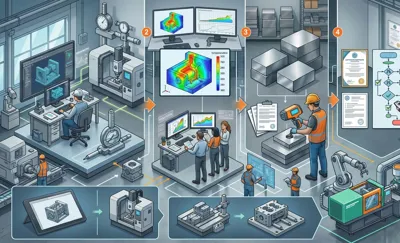
Guide to choosing a plastic injection mold manufacturer.
Choosing a plastic injection mold manufacturer involves verifying the supplier's CAD/CAM infrastructure, CNC precision limits (in the micron range), DFM (Design for Manufacturability) competence, and compliance with ISO 9001/IATF 16949 quality management systems. A reliable mold manufacturer should document steel supply with spectrometer analysis certificates (DIN 1.2344, 1.2738, etc.), provide Moldflow flow simulation outputs, and guarantee mold life according to international SPI (Society of Plastics Industry) standards. Integrating design, manufacturing, and mass production injection lines under a single roof reduces project operational risks by 40%.