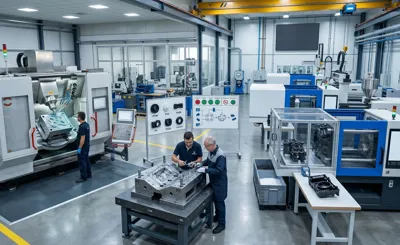
Plastic injection mold prices and cost guide.
Plastic injection mold prices are determined by part dimensions (mm), cavitation (number of cavities), mechanical core/hydraulic system requirements, and the metallurgical properties of the selected steel alloy (1.2344, 1.2738, 1.2311). Hot runner integration reduces runner waste to zero while increasing the initial mold investment cost by 15% to 30%. Mold life classes are classified as Class 101 (1 million+ cycles) and Class 103 (less than 100,000 cycles) according to SPI (Society of Plastics Industry) standards, and pricing is directly optimized according to these engineering classes.
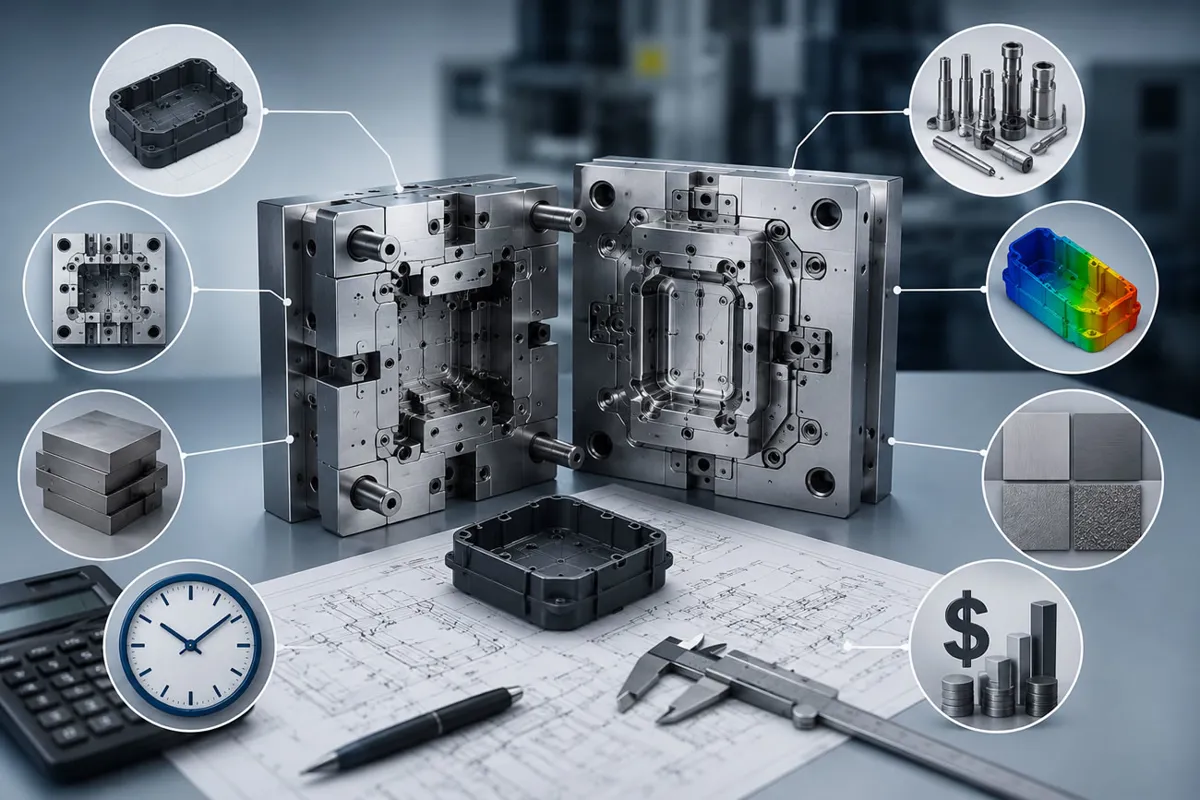
Technical Criteria Determining Plastic Injection Mold Costs
For purchasing professionals, factory managers, and project engineers who will be supplying industrial parts in B2B markets, plastic injection mold prices constitute the largest item in the initial investment budget. However, there is no standard unit price or cost per m² in mold manufacturing. Each mold is a special engineering project designed from scratch according to the design of the part to be produced, the melt index (MFI) of the raw material to be used, and the targeted annual production volumes. To eliminate uncertainties in the pricing process, it is necessary to thoroughly analyze the technical parameters that make up the cost structure.
1. Part Geometry and Mold Complexity (Undercuts and Cores)
The design of the plastic part to be produced is the main determinant of the mold price. Undercuts, internal screws, lugs, or holes on the part prevent the molten plastic from exiting the mold in a straight line. In such cases, it is necessary to add movable mechanisms inside the mold, namely sliders, hydraulic or mechanical systems, and mechanical pin groups for claw release. The presence of side sliders directly increases mold machining labor, electro-erosion (EDM) processes, and CNC milling cycle times, which is reflected linearly in the mold price.2. Cavitation (Mold Cavity Number) and Cycle Time Optimization
The number of parts produced in the same injection cycle directly affects the mold price. A single-cavity mold is much more economical in the initial investment phase than a multi-cavity mold (e.g., 4, 8, 16, or 32 cavities). However, in high-volume mass production projects, producing parts with a single-cavity mold excessively increases the unit part cost and labor costs. Purchasing specialists should optimize the number of cavities according to the total order projection. As the number of cavities increases, the dimensions of the mold block increase, the rheological balance becomes more complex, and the price increases; however, the cost per part is minimized.
3. Steel Selection and SPI Mold Life Standards
How long the mold will operate while maintaining its dimensional tolerances depends on the quality of the steel used in the mold blocks and the heat treatment (hardening) processes. In the plastics industry, mold lifetimes are classified according to international SPI (Society of Plastics Industry) standards, and this directly dominates the mold budget.4. Runner Technology: Cold Runner vs. Hot Runner Investment Difference
Another important component affecting plastic injection mold prices is the runner system. In cold runner systems, the plastic in the runner channel solidifies along with the part after injection, and plastic waste (scrap) occurs in each cycle. In hot runner systems, the runner channels are kept constantly hot with resistors, the plastic remains in a molten state, and scrap is reduced to zero. Hot runner integration increases the mold manufacturing cost by 15% to 30%; However, in high-tonnage production, it allows the mold to amortize itself in a short time by saving on engineering plastics (PA66, PEEK, PC).Ways to Avoid Hidden Costs in B2B Mold Specifications
Focusing only on the cheapest mold offer in the supplier selection process can lead to much greater financial losses in the long run due to production stoppages, burr problems, and dimensional discrepancies. The geometry of the in-mold cooling channels (homogeneous cooling), the hardness grades of the wear plates, and the part surface finish (texture or polishing standard) should be clearly specified in the technical specification. A well-designed system can shorten the mold cycle time in the injection molding machine by nearly 20%, permanently reducing energy and depreciation costs per part.
Frequently Asked Questions (FAQ)
What data is needed to get a plastic injection mold quote?
For an accurate plastic injection mold price estimate, the 3D CAD data of the part (in STEP, IGES, or X_T format), the type of raw material of the part (PP, ABS, PA6, PC, etc.), the targeted annual production volume, and the expected surface quality (texture, gloss) must be shared.
How does the hot runner system affect the mold price?
The hot runner system increases the initial manufacturing cost of the mold because it requires a manifold, resistors, and a temperature control unit. However, it reduces total production costs in the medium and long term because it eliminates waste per part and shortens cycle time.
What is the role of steel hardness in plastic mold prices?
Pre-hardened steels (e.g., 1.2311) are processed faster and have a more affordable mold price because they do not require heat treatment. High-strength steels such as 1.2344, on the other hand, are subjected to heat treatment (50-52 HRC) in vacuum furnaces after CNC machining. This additional process extends the mold life to millions of units and is reflected in the price.
The Right Mold Investment and Cost Analysis for Your Project
Share your technical data with us for high part quality and optimized mold costs in your B2B projects. Our engineering team will provide you with the most rational price quote tailored to your needs with the most accurate cavitation and steel analysis.
Recommended for You
Automotive rubber and plastic parts manufacturing and OEM solutions.
In the automotive sub-industry, the production of rubber and plastic parts is carried out according to IATF 16949 Quality Management System standards. Active production processes include high-temperature and oil-resistant ACM, AEM, and FKM (Viton) compounds for engine seals, and natural rubber (NR) and EPDM formulations for dynamic damping in suspension lines. Dimensional verifications are performed using 3D CMM devices within the scope of PPAP (Production Part Approval Process) processes and are guaranteed to meet TS ISO 3302-1 M1/M2 accuracy classes.