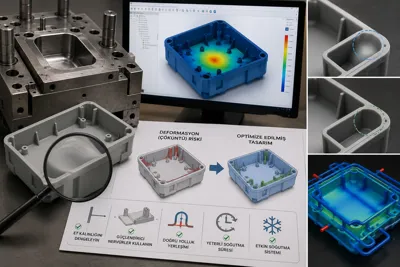
Guide to choosing a plastic injection mold manufacturer.
Choosing a plastic injection mold manufacturer involves verifying the supplier's CAD/CAM infrastructure, CNC precision limits (in the micron range), DFM (Design for Manufacturability) competence, and compliance with ISO 9001/IATF 16949 quality management systems. A reliable mold manufacturer should document steel supply with spectrometer analysis certificates (DIN 1.2344, 1.2738, etc.), provide Moldflow flow simulation outputs, and guarantee mold life according to international SPI (Society of Plastics Industry) standards. Integrating design, manufacturing, and mass production injection lines under a single roof reduces project operational risks by 40%.

Financial and Operational Risks of Selecting a Mold Manufacturer in B2B Supply Chains
In the industrial manufacturing sector, the most critical milestone in bringing a new plastic part or housing component to life is establishing a partnership with the right plastic injection mold manufacturer. For B2B procurement managers, R&D engineers, and factory executives, mold investment represents a significant and largely irreversible capital expenditure (CAPEX). Choosing the wrong supplier can lead to defective part geometries, extended cycle times, frequent mold downtime during mass production, and ultimately missed time-to-market targets. For this reason, supplier selection should be based on engineering and technical audit criteria rather than traditional price-focused approaches.
1. Engineering and Design Validation (DFM & Simulation) Capabilities
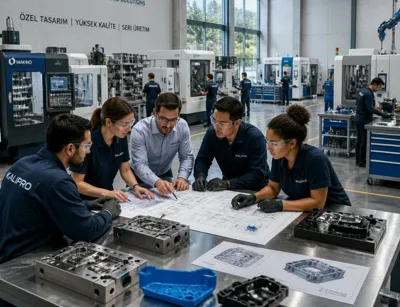
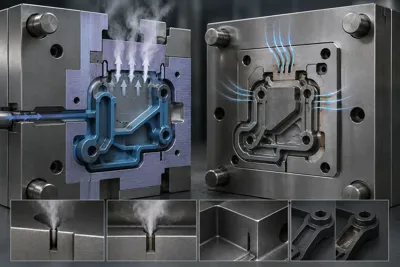
A professional mold manufacturer does not immediately begin machining steel upon receiving a project. The longevity and efficiency of a mold depend heavily on the design validation processes performed before manufacturing begins. The supplier's ability to provide a comprehensive DFM (Design for Manufacturing) report should be carefully evaluated. Draft angles, wall thickness distribution, and core-pulling mechanisms must be analyzed using advanced engineering software. In addition, Moldflow simulations that visualize polymer flow, weld lines, and potential air traps during injection molding are essential prerequisites for achieving a defect-free mold design.
2. Metallurgical Assurance: Certified Steel and Heat Treatment Verification
One of the most common issues in the mold manufacturing industry is the use of low-quality or incorrectly specified steel grades in mold blocks. A reliable mold manufacturer must be able to prove the metallurgical origin of the steel used in both the mold base and cavities.
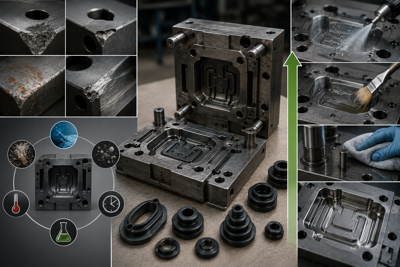
Request spectrometer analysis reports and material certificates for the steel grades used (e.g., DIN 1.2344, 1.2738, or 1.2083). Furthermore, for high-volume production molds, the Rockwell hardness (HRC) values achieved after vacuum heat treatment should be documented through independent laboratory reports or calibrated testing equipment. This verification helps prevent premature mold wear and cracking.
3. Machine Capacity, CNC Technology, and Micron-Level Tolerance Control
The engineering expertise of a mold manufacturer can only become reality through the machining technologies available in its production facility. To manufacture molds capable of producing high-precision plastic components, cavity surfaces must be machined with micron-level accuracy (typically between 0.005 mm and 0.01 mm). During supplier audits, the capabilities of CNC machining centers, the precision of EDM (Electrical Discharge Machining and Wire EDM) equipment, and the availability of CMM (Coordinate Measuring Machine) systems for dimensional verification should be evaluated on-site.
4. Integrated Service Capability: Mold Manufacturing and Mass Injection Molding Under One Roof
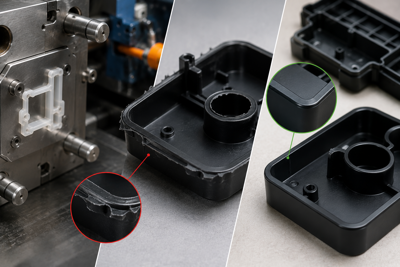
Operational fragmentation is always a risk factor in B2B supply chain management. When mold manufacturing is outsourced to one vendor and mass production is handled by another injection molding company, determining responsibility for defects such as flash, sink marks, or dimensional deviations becomes extremely difficult. The ideal solution is to work with suppliers that integrate mold design, mold manufacturing, CNC machining, T1 sampling, and high-volume mass production plastic part molding within a single facility. This level of integration minimizes quality risks and logistics costs.
Supplier Audit Checklist: Golden Rules for Procurement Professionals
Before placing an order or signing a contract with a plastic mold manufacturer, request written answers to the following technical questions:
-
Are material origin certificates and heat treatment certificates provided for mold steels?
-
Is the mold lifespan contractually guaranteed according to international SPI standards (Class 101, 102, etc.)?
-
Are Moldflow flow and cooling analysis reports shared before manufacturing begins?
-
Are T1 sampling trials conducted using the supplier's own injection molding machines?
-
Can the supplier provide CMM dimensional inspection reports as part of the PPAP documentation package?
Frequently Asked Questions (FAQ)
Why Should the SPI Mold Class Be Included in the Contract?
SPI (Society of the Plastics Industry) mold classifications define how many production cycles a mold can perform without generating flash or dimensional deviations. For example, a Class 101 mold is the highest classification and is designed for more than one million cycles. Including the SPI classification in the contract provides legal assurance regarding the steel quality and workmanship committed by the supplier.
How Should Mold Revisions and Modifications Be Managed?
For product design changes that occur after mold completion, the mold manufacturer should possess robust CAD/CAM and reverse engineering capabilities. In integrated facilities, steel additions, laser welding, and CNC re-machining operations can be performed quickly, preventing disruptions to mass production schedules.
How Does Choosing an Integrated Mold and Injection Molding Supplier Reduce Costs?
Because mold design is developed simultaneously with the injection molding machine parameters (such as screw-barrel configuration and injection pressure), T1 trial processes are shortened, runner waste is optimized, and subcontracted transportation and logistics costs are eliminated.
Entrust Your Projects to Our Integrated Manufacturing Facility Without Risk
Leave behind the operational risks associated with uncertified steels, simulation-free designs, and fragmented subcontracted production. As kaucukplastikkalip.com, we manage every stage under one roof—from design and advanced engineering analyses to micron-precision mold manufacturing and high-volume mass production. Share the technical details of your next project and let our expert team establish a secure and reliable B2B partnership tailored to your needs.
Recommended for You
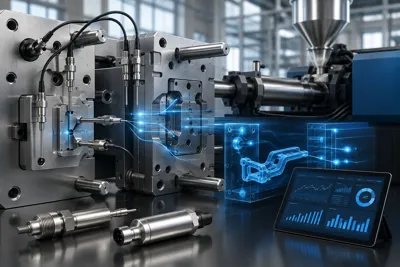
Smart injection with in-mold pressure sensors.
In-mold pressure and temperature sensors are piezoelectric and infrared (IR) based Industry 4.0 devices that measure the dynamic rheological state of the molten polymer in mold cavities in milliseconds. Instead of relying on the hydraulic pressure of the injection molding machine, these systems read the actual plastic pressure directly within the cavity; they dynamically manage the velocity-to-pressure switchover using the Decoupled III methodology. This technology compensates for inter-batch viscosity fluctuations, preventing flash, short shots, and shrinkage marks at the source, and integrates with part sorting robots to ensure 100% part quality classification.