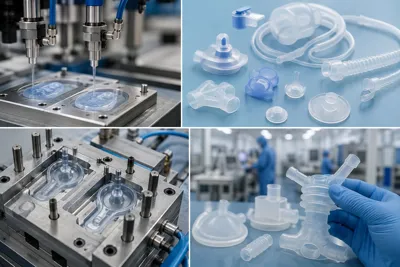
Medical LSR (Liquid Silicone) molding technology
In the medical sector, LSR (Liquid Silicone Rubber) molding is an advanced manufacturing method achieved by precisely dosing two-component (A and B) low-viscosity platinum-cured silicone at a 1:1 volumetric ratio, mixing it in a static mixer, and injecting it into hot mold cavities (170°C - 200°C). This process, conducted under ISO 13485 quality management system and ISO Class 7/8 cleanroom infrastructure, ensures full compliance with USP Class VI and ISO 10993 biocompatibility standards, zero flashless precision, and micron-level micro-injection capability. Cold-deck closed valve systems minimize raw material waste.
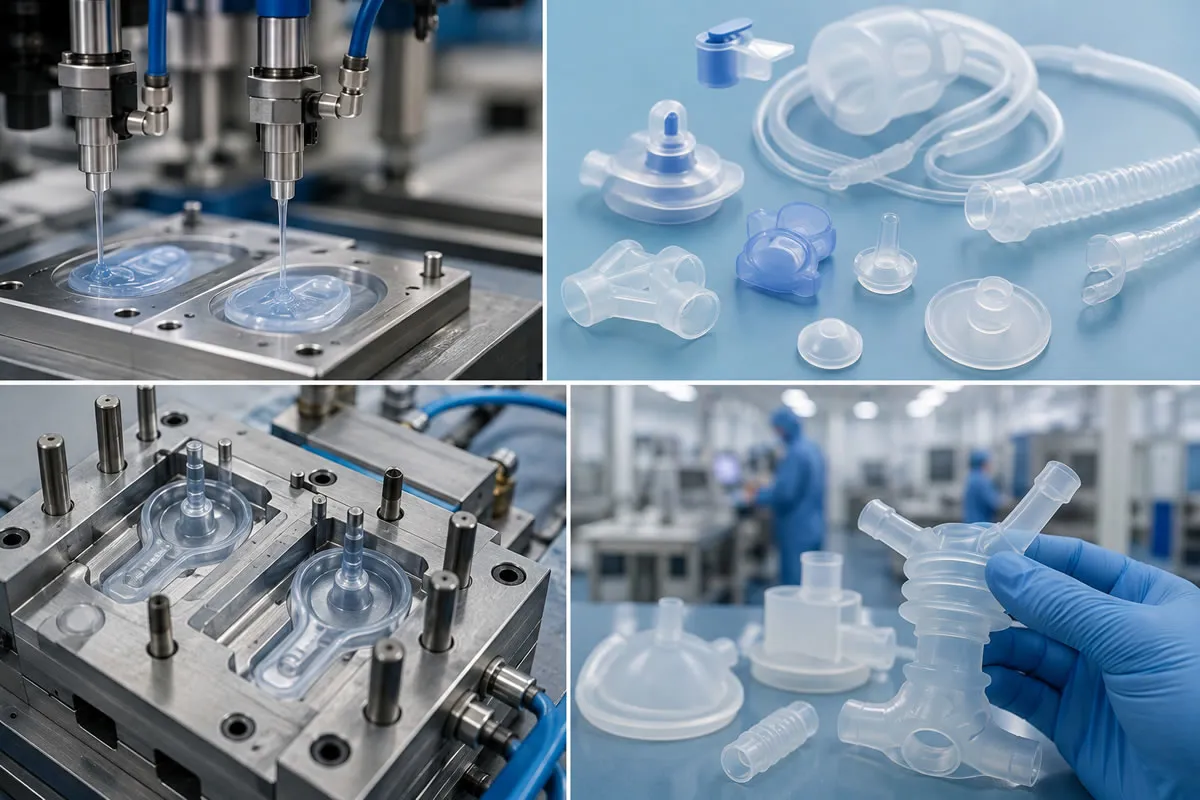
Why is LSR Preferred in Medical Devices and Disposables?
When it comes to biomedical engineering, surgical instruments, and implantable devices, material reliability is directly linked to human life. Because conventional methods—such as the compression molding of high-consistency rubber (HCR)—require intensive labor and present contamination risks, the modern medical industry has shifted toward LSR (Liquid Silicone Rubber) injection molding technology.
LSR is processed by combining two liquid-phase components in a closed, touchless injection system. Its inert chemistry, absolute biocompatibility with tissue and bodily fluids, ability to retain elasticity between -50°C and +200°C, and resistance to repeated autoclaving (steam sterilization) make LSR an indispensable engineering material for respiratory masks, dialysis valves, catheter tips, infusion pump diaphragms, and surgical instrument grips.
Working Principle of the LSR (Liquid Silicone Rubber) Injection Process
The LSR process operates with a thermal architecture virtually opposite to standard thermoplastic injection molding:
1. Dosing and Static Mixing of Components A and B
Raw material is drawn from 20-liter pails or 200-liter drums via high-precision hydraulic or servo metering pumps. Component A contains the silicone polymer base and platinum catalyst, while Component B contains the cross-linker and reaction inhibitor. These two liquid components are metered at a 1:1 ratio with microliter precision and passed through a chilled static mixer to yield a completely homogeneous blend. If required, biocompatible liquid medical colorants are also metered into the stream at this stage.
2. Chilled Barrel and Cold Runner (Cold Deck) Blocks
The homogeneous mixture enters a barrel-and-screw unit water-cooled to 15°C - 25°C. Unlike thermoplastics, LSR must remain cold; otherwise, premature vulcanization occurs inside the barrel. A cold runner (cold deck) block integrated into the mold keeps the silicone chilled and fluid right up to the nozzle tips, enabling production with zero runner scrap in every cycle.
3. Rapid Platinum Vulcanization in Heated Mold Cavities
The chilled silicone compound is injected into heated mold cavities maintained at 170°C - 200°C via electric cartridge heaters. Upon exposure to high mold temperatures, the platinum catalyst triggers cross-linking within seconds. Depending on part wall thickness, cycle times drop to an ultra-fast 15 to 40 seconds.
Critical Criteria in Medical LSR Mold Design: Zero Flash and Vacuum Integration
The dynamic viscosity of unvulcanized LSR is close to that of water, meaning the compound can creep into the smallest micro-clearances. Consequently, medical LSR molds are engineered according to the following advanced standards:
-
Micron-Level Parting Line Tolerances: To prevent flash formation, parting line clearances between the core and cavity halves must strictly not exceed 0.002 mm - 0.003 mm (2-3 microns). Cavities are machined from hardened, corrosion-resistant stainless tool steel DIN 1.2083 ESR.
-
Integrated In-Mold Vacuum System: Immediately before silicone injection, air inside the cavity is evacuated within seconds via high-performance vacuum pumps (vacuum < 10 mbar). This process completely eliminates air traps, scorch marks (dieseling), and micro-bubble voids in intricate micro-features.
-
Valve-Gated Cold Runner Nozzle Technology: Pneumatic or servo-actuated mechanical shut-off needles are utilized at the cold runner manifold drops. Upon completion of injection, the needle closes flush against the cavity gate, leaving virtually zero gate vestige on the finished part.
LSR vs. High-Consistency Rubber (HCR) and TPE: Medical Performance Benchmark
| Characteristic / Standard | LSR (Liquid Silicone Rubber) | HCR (Solid Silicone Rubber) | Medical-Grade TPE (Thermoplastic) |
| Cure Mechanism | Platinum-Cured (Addition / Zero Byproducts) | Primarily Peroxide-Cured | No Cure (Physical Solidification) |
| Manufacturing Automation | Fully Automated, Touchless | Labor-Intensive / Manual Deflashing | Fully Automated |
| Compression Set | Excellent (~15%) | Good (20% - 30%) | Poor / Moderate (~40%) |
| Autoclave & Sterilization Resistance | High-Heat Steam, Gamma, EtO | High-Heat Steam, Gamma | Limited (Low Heat Deflection Temperature) |
| Flash Risk | Zero (Flashless Tooling Technology) | High (Manual Trimming Required) | Low |
Cleanroom and Regulatory Standards in B2B Medical Part Manufacturing (ISO 13485 & ISO 10993)
In qualifying a medical component supplier, validated quality infrastructure is paramount. At kaucukplastikkalip.com, we ensure the following international compliance framework for our B2B medical partnerships:
-
ISO 13485 Medical Devices Quality Management System: Complete documentation of all phases from tooling design to molding and final packaging, governed by risk management (FMEA) and qualification protocols (IQ, OQ, PQ).
-
ISO Class 7 / Class 8 Cleanrooms: Fully automated robotic molding and medical pouch sealing in positive-pressure cleanroom environments with continuous particle count, humidity, and temperature monitoring.
-
Biocompatibility Assurance (ISO 10993 & USP Class VI): 100% certified medical-grade raw materials rigorously tested for cytotoxicity, sensitization, irritation, and systemic toxicity.
Frequently Asked Questions
Do LSR components require secondary oven curing (post-cure)?
Most platinum-cured medical LSR compounds achieve complete vulcanization inside the tool and do not require post-curing. However, for critical components intended for direct human implantation or respiratory airpaths, a 4-hour thermal bakeout at 150°C - 200°C is recommended to drive off remaining trace volatile siloxanes.
Can liquid silicone and thermoplastics be combined in a single mold (2K LSR)?
Yes. Utilizing two-component (2K / multi-component) injection molding machines, a rigid medical thermoplastic (e.g., PBT, PA, or PC) is injected first; subsequently, via a rotary platen tool mechanism, LSR is overmolded directly onto the thermoplastic within the same tool to achieve molecular and mechanical bonding in a single cycle.
What is the minimum part shot weight achievable with Micro-LSR molding?
Equipped with specialized micro-injection screws and precision dosing equipment, micro medical check-valves and hearing aid seals weighing as low as 0.005 grams (5 milligrams) can be manufactured with micron-level repeatability.
High-Precision LSR Tooling and Manufacturing Solutions for Medical Projects
When developing critical medical components that interface with human health, there is no margin for error in biocompatibility or dimensional accuracy. At kaucukplastikkalip.com, we engineer high-precision LSR molds from DIN 1.2083 ESR stainless tool steel, producing flashless medical components backed by cold deck and vacuum technologies. Share your 3D CAD data today to explore our ISO 13485-compliant manufacturing and USP Class VI-certified infrastructure, and receive your expert technical proposal immediately.
Recommended for You
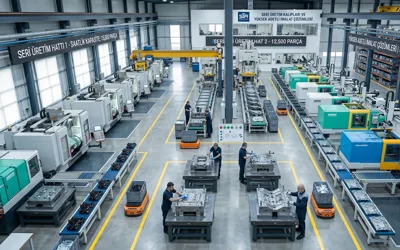
Mass production molds and high-volume manufacturing solutions.
High-volume series production mold manufacturing is an engineering discipline applied to minimize cycle times and increase line efficiency (OEE) to over 85%. In high-volume manufacturing lines, powder metallurgical steels (Bohler M390, Elmax, etc.) with a hardness of 52-54 HRC according to the SPI Class 101 standard and corrosion-resistant DIN 1.2083 alloys are used. In multi-cavity molds, hot runner systems and conformal cooling channels that follow the part geometry in 3D are integrated for a balanced polymer distribution.