Defense industry rubber part manufacturing, Military standards.
Defense industry rubber component manufacturing is the process of producing elastomer components that withstand extreme environmental conditions in accordance with MIL-STD, MIL-SPEC, and ASTM standards. Sealing elements and damping pads produced for military land, sea, and air platforms are molded with traceable raw materials compliant with the NATO codification system. Mechanical testing of FKM (Viton), Fluorosilicone (FVMQ), and Nitrile (NBR) based components produced for hydraulic systems, fuel tanks, and avionics protection units is verified and certified on a part-by-part basis in accredited laboratory environments.
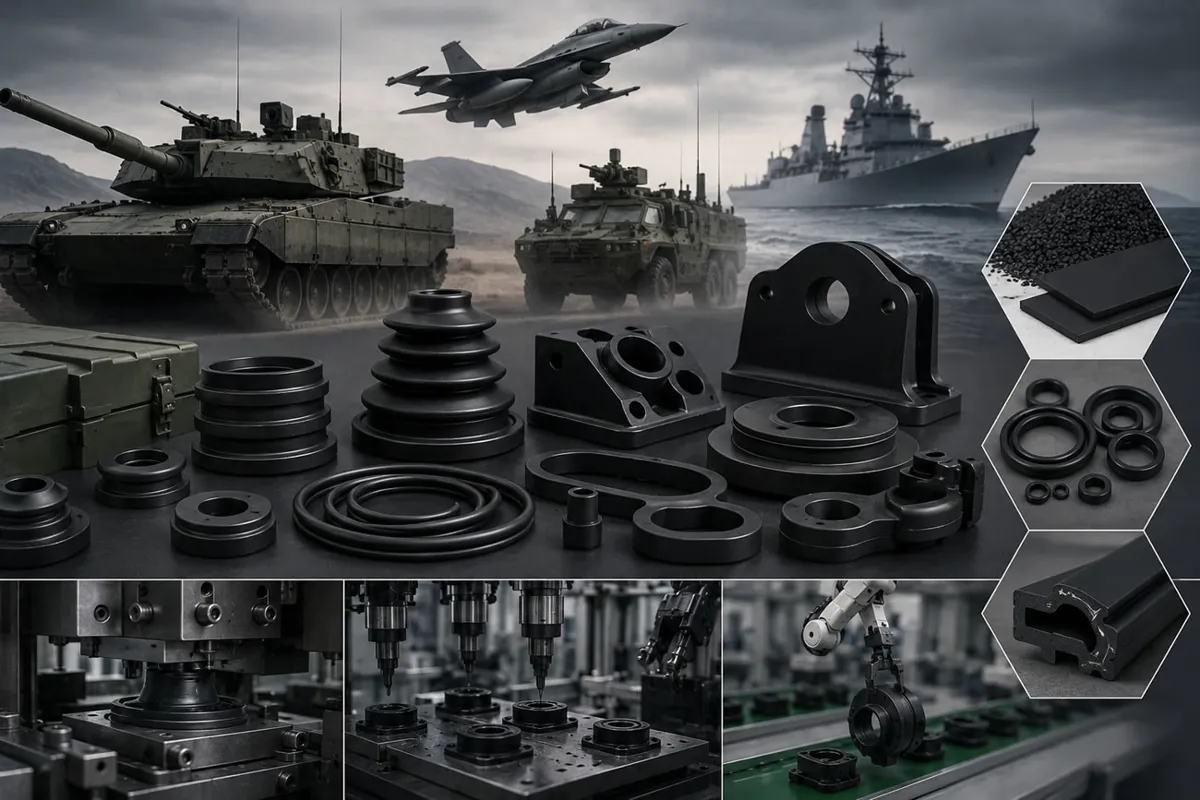
Critical Functions of Rubber Components Used in the Defense Industry
The defense, aerospace, and space industries demand zero tolerance for failure and maximum operational reliability from every component used. Defense industry rubber components utilized in military ground vehicles, armored personnel carriers, unmanned aerial vehicles (UAVs/UCAVs), missile systems, and submarine platforms must perform flawlessly even under the harshest combat conditions. Failure of a sealing gasket or a vibration-damping mount can render military platforms worth millions of dollars inoperable. For this reason, the mold design and manufacturing of military elastomeric components require a completely different engineering approach compared to conventional industrial applications.
Military Standards and Certification Processes: MIL-SPEC and ASTM Standards
B2B suppliers producing components for military projects must comply fully with globally recognized military specifications (MIL-SPEC). During the design and formulation stages, the mechanical and chemical requirements defined by these standards are strictly applied:
MIL-R-83248 and Fluoroelastomer (FKM) Applications
This military standard covers hydraulic and fuel line systems used in aerospace and missile applications where high-temperature and aggressive fluid resistance are required. FKM (Viton) components manufactured in compliance with this specification maintain their structural integrity when exposed to jet fuels (JP-8) and synthetic lubricants.
MIL-G-21580 Sealing and Protection Requirements
This specification defines the performance limits for seals used to protect military ammunition containers, electronic warfare (EW) enclosures, and avionics systems against moisture, dust, and chemical gas infiltration. Manufactured seals are tested to achieve IP67/IP68 sealing performance levels.
Advanced Elastomer Matrix for Extreme Conditions
Military platforms operate across a wide thermal spectrum, ranging from -50°C polar environments to engine compartments and exhaust systems exceeding +200°C. To withstand these extreme conditions, specialized elastomer materials are selected for specific applications:
-
Fluorosilicone (FVMQ): Combines the extreme temperature resistance of silicone (-60°C to +200°C) with the fuel and oil resistance of fluorocarbon materials. It is commonly used for O-rings and diaphragms in aerospace fuel systems and high-altitude UAV programs.
-
High-Performance EPDM (Peroxide-Cured): Provides exceptional resistance to thermal aging, ozone, and UV exposure. It is widely used as a seawater sealing material in military naval platforms, including both surface vessels and submarines.
-
HNBR (Hydrogenated Nitrile Butadiene Rubber): Offers significantly greater mechanical strength and wear resistance compared to conventional NBR. It is used in armored vehicle driveline systems, heavy-duty sealing boots, and transmission seals.
Traceability, Laboratory Testing, and Quality Assurance for Defense Applications
When supplying military-grade rubber components for defense projects, complete traceability from raw material mixing to final shipment is both a legal and technical requirement. For each production batch, rheometer curing curves, Shore A hardness measurements, tensile strength tests, and compression set evaluations in accordance with ASTM D395 are performed with strict precision. All test results are archived as Certificates of Conformance (CoC) and detailed inspection reports for submission to procurement and quality assurance departments.
Strategic Confidentiality and Mold Security in B2B Supply Chains
Due to the nature of defense industry projects, information security and design confidentiality must be protected at the highest level. Project-specific 3D CAD data, technical specifications, and custom-designed steel molds are stored on local servers secured by advanced cybersecurity protocols. NATO Stock Number (NSN) tooling and molds manufactured for national defense programs are maintained in controlled-access areas, ensuring complete operational security and confidentiality for our B2B partners.
Frequently Asked Questions (FAQ)
Why Is Compression Set Critical for Military Rubber Components?
Compression set refers to the ability of a rubber seal to return to its original shape after prolonged compression. Since military seals are expected to maintain leak-free performance for years while installed, a low compression set value (preferably below 20%) directly determines the service life and reliability of the seal.
How Is a Mold Manufactured for a NATO Stock Number (NSN) Rubber Component?
The mold manufacturing process for a component included in the NATO codification system is carried out according to the dimensional tolerances specified in official technical drawings (typically TS ISO 3302-1 M1 precision class) and the required material specifications. Both the mold and the produced components are released for serial production only after approval by the relevant military quality authorities, such as Ministry of Defense representatives or designated prime contractor inspectors.
Why Is Fluorosilicone (FVMQ) Preferred Over Standard Silicone in Aerospace Applications?
Although standard silicone rubber provides excellent temperature resistance, it has poor resistance to hydrocarbons such as fuels and oils and may swell upon exposure, resulting in loss of dimensional stability. Fluorosilicone, however, offers superior sealing performance against jet fuels while retaining the flexibility and temperature resistance characteristics of silicone.
Reliable Manufacturing Partner for National and Strategic Defense Projects
For your defense and aerospace rubber molding and component manufacturing projects requiring high traceability and compliance with military standards, share your technical specifications with us. Our engineering and R&D teams will prepare secure, MIL-SPEC-compliant B2B solutions and customized quotations tailored to your project requirements.
Recommended for You
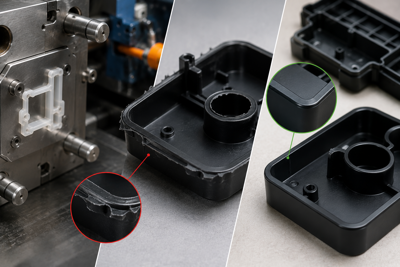
Burr problems in plastic injection molding and solutions.
In plastic injection molding, flash is a dimensional and aesthetic manufacturing defect caused by molten polymer leaking out of mold parting lines, core surfaces, or ejector pin cavities under high injection pressure (>1000 bar). This problem stems from insufficient clamping force, excessive injection speed, mechanical crushing or abrasion of mold kissing surfaces, or polymer melt temperatures that excessively reduce viscosity. Solutions include optimizing compression ratios through Moldflow analysis and revising mold steels with micron-precision laser welding or CNC grinding.