Technical plastic products and industrial applications.
Technical plastic products are components manufactured using engineering plastics (PA6, PA66, POM, PC, PEEK) that, unlike conventional polymers, offer high mechanical strength, thermal stability up to 100°C, chemical resistance, and a low coefficient of friction. They are frequently preferred in metal replacement projects in heavy industry, machinery, automotive, and defense sectors. Production validations are carried out according to ISO 20457 geometric tolerance standards by optimizing the crystallization kinetics and orientation parameters of the polymers.
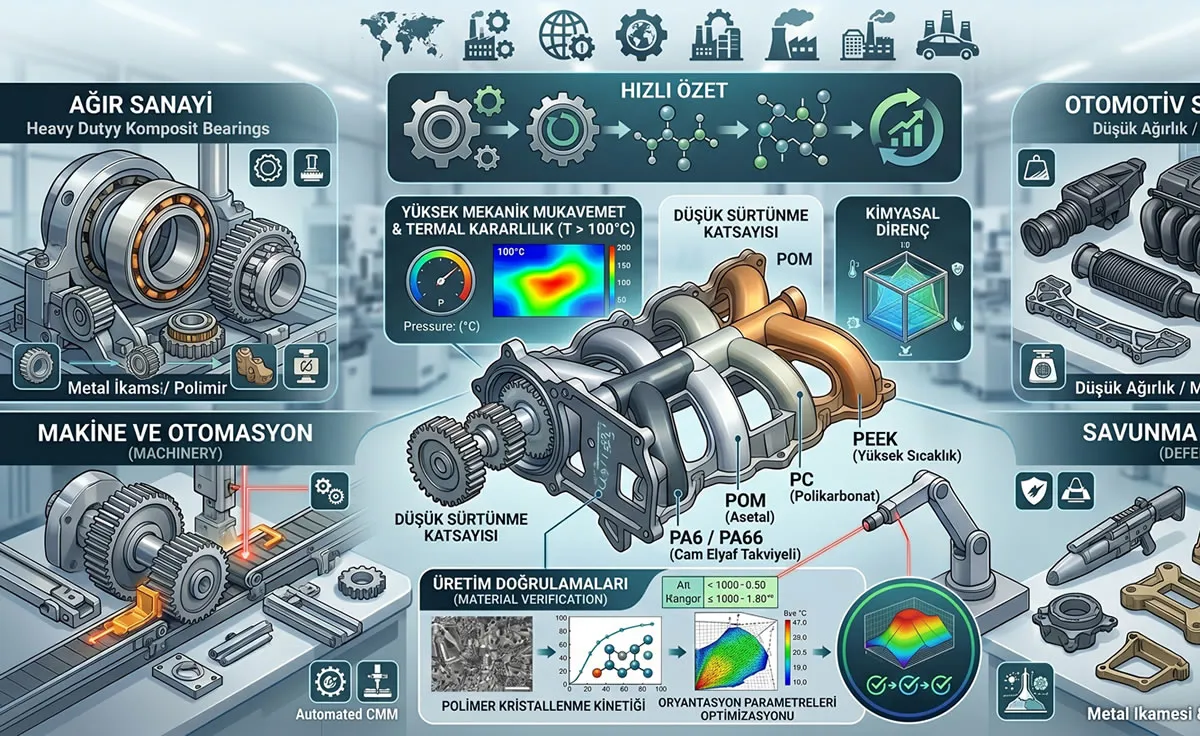
Why Are Engineering Plastic Products Preferred in Industrial Manufacturing?
While conventional polymers such as PP, PE, and PS provide cost-effective solutions for everyday applications including packaging and household products, industries such as heavy manufacturing, machinery, automotive, aerospace, and defense require materials capable of withstanding far more demanding mechanical and thermal conditions. Engineering plastics are advanced polymeric materials specifically developed to maintain their structural integrity under continuous mechanical loads, resist creep deformation, withstand aggressive chemical environments, and preserve their mechanical properties at elevated operating temperatures. Selecting the appropriate engineering plastic for a B2B industrial project not only extends the service life of the system but also significantly reduces component weight and overall manufacturing costs.
Metal Replacement and Its Engineering Advantages
One of the most significant trends in modern industrial product design is replacing brass, aluminum, zinc die-cast (Zamak), and even steel components with engineering plastic parts. This process is widely known as metal replacement. Engineering polymers such as glass fiber-reinforced polyamide (PA) and PEEK, enhanced with glass fiber (GF), carbon fiber (CF), or mineral fillers, can achieve tensile and flexural strengths approaching those of metals. Replacing metal components with engineering plastics reduces component weight by approximately 50% to 70%, completely eliminates corrosion risks, removes secondary machining operations such as drilling, tapping, and grinding, and enables the production of highly complex geometries within a single injection molding cycle.
The Most Common Engineering Plastics and Their Key Characteristics
During our industrial component manufacturing processes, the most suitable engineering polymer is selected according to each project's technical specification to ensure optimum mechanical performance, dimensional stability, and long-term durability.
Polyamide (PA6 / PA66) – High Mechanical Strength
Commonly known as nylon, polyamides offer excellent wear resistance together with outstanding mechanical rigidity. When reinforced with 30% to 50% glass fiber (GF), PA6 and PA66 are capable of directly replacing metal in applications such as engine covers, intake manifolds, radiator end tanks, and structural mounting brackets. Due to their hygroscopic nature, proper pre-processing drying under controlled dew point conditions is critical before injection molding in order to achieve consistent mechanical properties and dimensional stability.
Polyoxymethylene (POM / Acetal) – Dimensional Stability and Low Friction
Often referred to as "plastic steel", Polyoxymethylene (POM) combines a high modulus of elasticity with exceptional dimensional stability and an extremely low coefficient of friction. Because its moisture absorption is nearly negligible, POM performs exceptionally well in high-precision gears, sliding bearings, fuel system components, locking clips, and industrial snap-fit mechanisms operating in humid or wet environments.
Polycarbonate (PC) – Impact Resistance and Optical Transparency
Polycarbonate is an amorphous engineering thermoplastic offering optical transparency comparable to glass while providing exceptionally high impact resistance—significantly exceeding that of acrylic materials. Its excellent heat resistance and optical clarity make it the preferred material for industrial safety glazing, avionics display panels, transparent medical components, and automotive lighting lenses.
How to Select the Right Engineering Plastic for B2B Industrial Projects
When a technical procurement specialist or R&D engineer prepares specifications for a new industrial plastic component, material selection should never be based solely on cost. Instead, the operating conditions and performance requirements of the application must be carefully evaluated. To ensure the optimum material is selected, manufacturers should be provided with detailed information regarding continuous and peak mechanical loads (static and dynamic stresses), exposure to chemicals such as oils, acids, and solvents, continuous operating temperature, and outdoor environmental conditions including ultraviolet (UV) radiation and ozone exposure. Based on these engineering parameters, our engineering team recommends the most suitable polymer grade together with the optimal mold design, ensuring long-term reliability and manufacturing efficiency for every project.
Frequently Asked Questions (FAQ)
How Does Glass Fiber Reinforcement (GF) Affect the Service Life of Engineering Plastics and Injection Molds?
Glass fiber reinforcement (for example, 30% GF) significantly improves the tensile strength, stiffness, dimensional stability, and thermal resistance of engineering plastics. However, molten glass fiber-reinforced polymers are highly abrasive as they flow through the mold cavity, causing accelerated wear on steel mold surfaces. For this reason, molds intended for processing glass fiber-reinforced engineering plastics should be manufactured from hardened hot-work tool steel grades such as DIN 1.2344 or corrosion-resistant DIN 1.2083, typically heat-treated to approximately 50–52 HRC, in order to maximize mold life and maintain dimensional accuracy throughout high-volume production.
What Is Creep in Plastic Component Manufacturing?
Creep is the tendency of a plastic component to undergo gradual and permanent deformation when subjected to continuous mechanical loading over an extended period. Engineering plastics—particularly POM and PA66—offer significantly greater creep resistance than commodity plastics, enabling them to maintain their dimensional integrity and mechanical performance for many years under sustained loading conditions.
Does Mold Design Change When Replacing Metal Components with Engineering Plastics?
Yes—fundamentally. Injection molds designed for metal die casting (such as aluminum or Zamak) differ substantially from plastic injection molds in terms of material shrinkage, gate design, runner systems, cooling channel configuration, and processing parameters. Consequently, the original metal component geometry should be redesigned according to Design for Manufacturing (DFM) principles, taking into account plastic-specific shrinkage behavior, rib design guidelines, wall thickness optimization, and injection molding requirements before production begins.
Strengthen Your Heavy Industrial Projects with Advanced Engineering Plastics
If your organization is implementing metal replacement projects to reduce component weight, eliminate corrosion, and lower manufacturing costs, we are ready to become your trusted engineering, mold manufacturing, and injection molding partner. Whether your project involves PA66, POM, PC, PEEK, or other high-performance engineering plastics, simply share your 3D CAD models, technical drawings, and performance specifications with our engineering team. We will prepare a customized B2B engineering solution together with a technically optimized and commercially competitive manufacturing proposal tailored to your project requirements.
Recommended for You
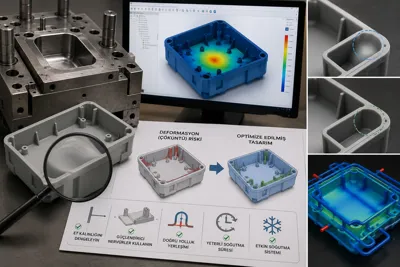
Indentation and deformation in plastic mold design.
Sink marks and dimensional warpage in plastic mold design result from volumetric shrinkage differences in areas with high wall thickness during the cooling phase of the molten polymer. To prevent these aesthetic and geometric defects, the base wall thickness should be kept homogeneous during the design phase, and the base thickness of the structural support ribs should be dimensioned so that it does not exceed 50% - 60% of the base wall thickness. Positioning the mold cooling channels at equal distances from the male and female cores and optimizing the holding pressure profile with Moldflow thermal simulations guarantees dimensional stability according to ISO 20457 standards.