Engineering plastics (PA6, POM, PC) and their properties.
Engineering plastics (PA6, POM, PC) are technical polymers that replace metal components in industrial manufacturing by offering high tensile strength (60 MPa), modulus of elasticity, dimensional stability, and thermal wear resistance. Polyamide 6 (PA6) exhibits high impact damping and mechanical toughness, while polyoxymethylene (POM/acetal) is used in precision mechanical gears due to its low coefficient of friction (0.15 - 0.25) and near-zero moisture absorption. Polycarbonate (PC), on the other hand, offers optimized engineering solutions for molding structurally transparent components with its high light transmittance (89%) and extreme impact resistance.
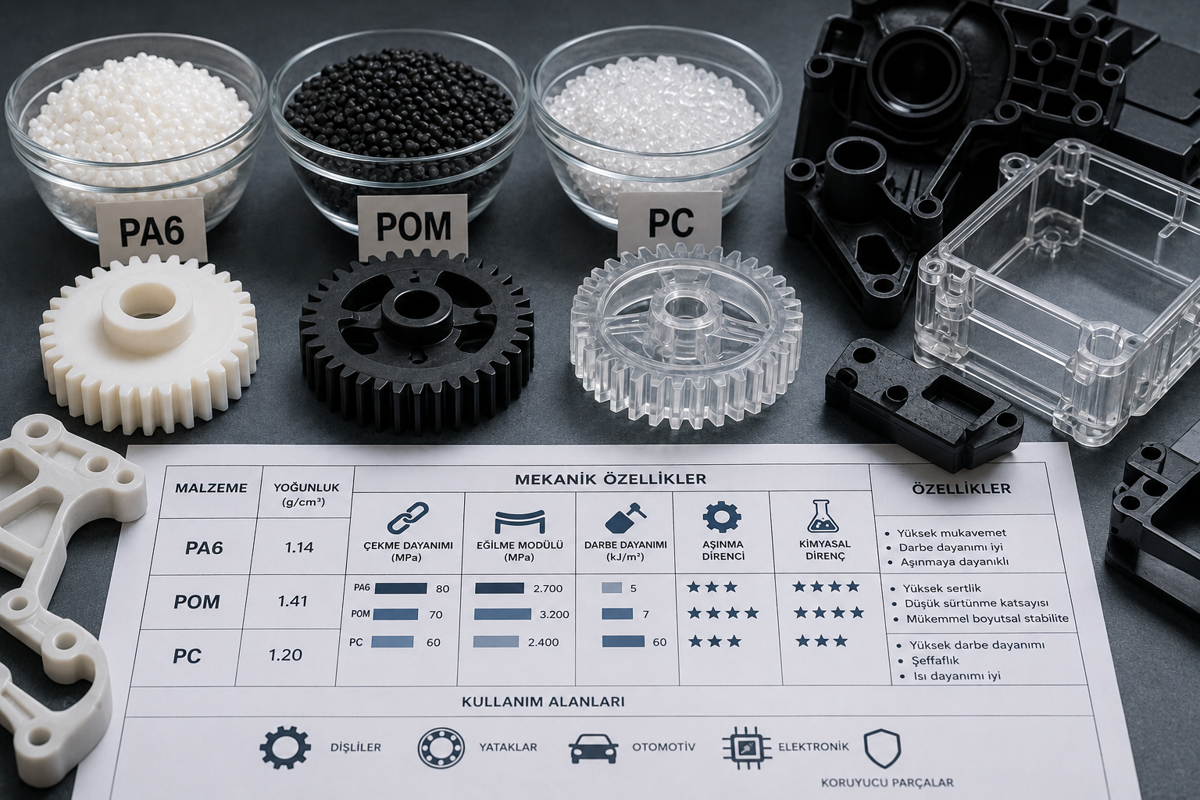
Differences Between Standard Plastics and Engineering Plastics in Industrial Manufacturing
In B2B industrial production lines, automotive sub-industries, and machinery manufacturing sectors, designing plastic components requires a comprehensive understanding of the mechanical limits of materials. While commodity plastics such as Polyethylene (PE) and Polypropylene (PP) provide efficiency in low-strength applications such as packaging and household products; engineering plastics are indispensable in applications exposed to structural loads, continuous friction, thermal stress, and chemical fluids. These polymers, also known as technical plastics, form the backbone of metal replacement projects by offering tensile strength values approaching metals thanks to their optimized molecular structures.
1. Polyamide 6 (PA6 - Akulon / Ultramid) – The Champion of Heavy Loads and Toughness
PA6, the most widely used member of the polyamide family, is known for its high mechanical strength, rigidity, and superior impact absorption capability.
PA6 Mechanical Properties and Moisture Absorption (Hygroscopic) Behavior
PA6 demonstrates excellent fatigue resistance and wear resistance under dynamic loads. However, the most distinctive chemical characteristic of polyamides is that they are hygroscopic (moisture absorbing) materials. After leaving the mold, the material absorbs moisture from the environment until it reaches a stable equilibrium state. Moisture absorption increases the impact resistance (toughness) and flexibility of the material, while slightly reducing tensile strength and hardness and causing micro-level dimensional expansion. This dimensional variation must be taken into consideration during the mold design phase.
The Effect of Glass Fiber (GF) Reinforcement on Mechanical Strength
When glass fiber (Glass Fiber - GF) is incorporated into PA6 raw material at ratios between 30% and 50%, the mechanical properties of the material change dramatically. The PA6 + 30% GF compound achieves 2.5 times higher tensile strength and 3 times higher elastic modulus compared to pure PA6. This reinforcement reduces moisture absorption, improves dimensional stability, and enables the material to replace metals in automotive engine covers, manifolds, and structural connection brackets.
2. Polyoxymethylene (POM - Acetal / Delrin) – Precision Tolerance and Low Friction
Polyoxymethylene (POM) is an irreplaceable engineering plastic known as "plastic steel" in industrial designs due to its highly crystalline structure and molecular stability.
POM Elastic Modulus and Dimensional Stability Criteria
The greatest advantage of POM is its near-zero moisture absorption. Therefore, even when operating in water or extremely humid environments, it maintains dimensional tolerances at micron levels (according to ISO 20457 standards). It provides high hardness, excellent spring-back capability (elastic recovery), and creep resistance. It does not lose its shape under continuous loads.
The Role of POM in Dynamic Conveyor and Gear Systems
POM has a self-lubricating surface structure. Due to its extremely low friction coefficient, it does not cause excessive wear or heat generation when operating against metal surfaces or other plastics. Thanks to these properties, it is preferred as a primary technical material in precision gears of industrial machines, conveyor chain bearings, fuel pump components, snap-fit connection elements, and automotive door lock mechanisms.
3. Polycarbonate (PC - Lexan / Makrolon) – Extreme Impact Resistance and Optical Clarity
Polycarbonate (PC) is a high-performance, engineering-grade thermoplastic with an amorphous structure.
While providing light transmission close to glass (approximately 89%), its impact resistance is at an extraordinary level comparable to steel (30 times more durable than acrylic / plexiglass materials). It does not break or crack under impact; instead, it absorbs energy and flexes. In addition, it has high thermal stability, capable of withstanding continuous operating temperatures up to +115°C. Safety protection visors, industrial machine guarding systems, avionics display covers, medical transparent tubes, and automotive headlight lenses are the primary molding applications of polycarbonate.
Engineering Plastic Molding Parameters in B2B Component Supply
The injection molding process of engineering plastics has a much narrower processing window compared to standard plastics. For example, when insufficiently dried Polycarbonate or Polyamide raw material enters the injection barrel, its molecular chains undergo hydrolysis and break down. This condition causes the part to become mechanically weak and fracture like glass under the slightest load during assembly, even though it may appear flawless externally.
As kaucukplastikkalip.com; we manufacture your technical plastic projects with their true mechanical performance values through our honeycomb desiccant dryers, in-mold conformal cooling control units, and micron-precision injection process management.
Frequently Asked Questions (FAQ)
Why is the "Conditioning" process performed after molding in polyamide parts?
A newly molded PA6 part is completely dry and brittle (fragile). In order for the part to reach its original strength and flexibility values, it is kept in hot water tanks or humidity chambers for a certain period to allow moisture absorption into its structure. This process is called conditioning and it completely prevents the breakage of clips and snap-fit features during assembly.
Why should POM (Acetal) be preferred instead of PA6 for gear manufacturing?
Polyamide 6 expands dimensionally when it absorbs moisture. This expansion causes axial distances to change in gear systems and leads to gear jamming and breakage. POM, on the other hand, maintains its dimensional shape because it does not absorb moisture and operates quietly and without wear even in oil-free environments thanks to its low friction coefficient.
What is the importance of mold steel selection in Polycarbonate (PC) molds?
Polycarbonate is a rigid material with high viscosity and requires high injection pressures for molding. In addition, since transparent parts are produced, the mold surface must have a perfect mirror-like finish. Therefore, PC molds require high-pressure-resistant and highly polishable hardened DIN 1.2083 ESR stainless mold steel with a hardness level of 50-52 HRC.
Let Us Produce Your Heavy-Duty Components with Advanced Engineering Plastics
Leave behind the high weight, corrosion risks, and expensive machining costs caused by metal components in your industrial systems by switching to engineering plastics. As kaucukplastikkalip.com, we stand beside you as your B2B manufacturing partner throughout all processes, from mold design to high-stability injection molding production, for your PA6, PA66 (%GF reinforced), POM, and Polycarbonate projects. Share your technical drawings and mechanical performance requirements with us, and let our expert engineers prepare a technical quotation specifically for your project.
Recommended for You
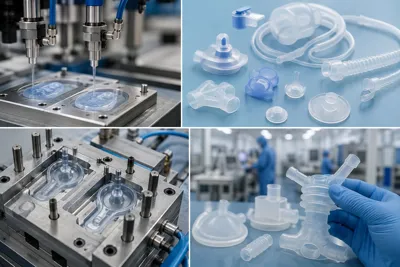
Medical LSR (Liquid Silicone) molding technology
In the medical sector, LSR (Liquid Silicone Rubber) molding is an advanced manufacturing method achieved by precisely dosing two-component (A and B) low-viscosity platinum-cured silicone at a 1:1 volumetric ratio, mixing it in a static mixer, and injecting it into hot mold cavities (170°C - 200°C). This process, conducted under ISO 13485 quality management system and ISO Class 7/8 cleanroom infrastructure, ensures full compliance with USP Class VI and ISO 10993 biocompatibility standards, zero flashless precision, and micron-level micro-injection capability. Cold-deck closed valve systems minimize raw material waste.